|
Places To See in Glocester
Whether you're a history buff or a nature enthusiast, there are many interesting places to visit in Glocester ...
Getting Around: Click here for a printable map showing the locations of many of the "Places To See" listed below. And be sure to visit the Glocester Town Hall to view the photo exhibit on display along the main corridor (open weekdays from 9:00am to 4:30pm).
Nature Enthusiasts: There are several sites within the Town of Glocester which have been preserved as historic and environmental treasures. Visit the Glocester Land Trust website to learn more about these beautiful "back to nature" spots and how to get there.
ACOTE'S HILL/ACOTE'S CEMETERY
Southern Jct. of Routes 44 & 102
Called Matony before 1800, this hill was renamed when an itinerant half-breed peddler known only as Acote mysteriously died of a fatal wound and a fall downstairs in Kimball Hotel. Acote was buried in an unmarked grave on the west side of the hill. In June of 1842, the hill was the site of an "armed but bloodless" confrontation between Thomas Wilson Dorr's "People's Rights" faction and Samuel Ward King's "Law & Order" party. Dorr eventually surrendered, was tried and sentenced to life imprisonment for high treason, but was released within a few years as a result of public outcry. A monument to Dorr's memory was erected at Acote's Hill in 1912. Click here for a brief history of the Dorr Rebellion.
MANNING ANGELL HOUSE (c. 1820)
Mr. Angell had a small tailor shop next to the road, on the southeast corner of the lot. This house became the church parsonage in 1963 after the Victorian parsonage north of the church was torn down.
JOB ARMSTRONG HOUSE (18th C./c. 1810)
The older portion can be seen at the rear of the building (note the difference in window height). Job Armstrong, a Justice of the Peace and Representative to the RI General Assembly, opened his home to numerous circuit preachers and religious pilgrims. His first store, which he soon outgrew, was in the basement. Sometime before 1820, he built a much larger store across the street (see Job Armstrong Store below). The original basement store was later used as a law office, rum shop, and meat market.
JOB ARMSTRONG STORE (bef. 1820)
1181 Main Street • 401-568-1866
Sat 11-3
By 1831, this was the largest of the thirteen dry goods and grocery stores in Chepachet, with 4 to 5 clerks working full-time. Although Armstrong was highly respected in the community, his business suffered after the Dorr Rebellion because he did not share the political views of his fellow villagers. The building was purchased by the Glocester Heritage Society in 1971 and was gradually restored. It is now the Headquarters of the Glocester Heritage Society, and includes a Visitor Center. Stop by to view the photo exhibit or to purchase books, maps, cards, photographs, and other GHS items. The public is welcome to attend monthly meetings. Historic and genealogical researchers by appointment only. Call 568-8967.
BAPTIST MEETINGHOUSE (1821)
The church was built by Clark Sayles and the bell was cast by G. Holbrook of Medway, MA. The Newport Artillery was billeted here during the Dorr Rebellion in 1842, and Old Home Days began there in 1903.
BENEFIT COMPANY STORE (c. 1800)
This store served the Benefit Mill workers. Its original facade was changed by a small addition to the front of the building (note the foundation).
THE BLOCK (1870's)
This was the mill tenement for White's Mill at the end of Tanyard Lane, which burned in 1897.
BROWN & HOPKINS STORE (1799)
|
|
|
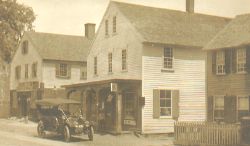
Photo courtesy of Dorothy Higson White
|
|
1179 Main Street • 401-568-4830
Built by Timothy Wilmarth, this is the nation's oldest continuously operating general store, dating from 1809. It was the site of Benjamin Cozzens Hattery for ten years, and then became Ann Evans' Store. Later years saw a succession of owners: I. Evans, H. Kimball, R. Wade, W. Read, Read & Potter, and Potter & Brown. Potter sold out to Brown in the early 1900's, and it has gone by the name Brown & Hopkins ever since. The present-day store features antiques, country furnishings, gourmet food, penny candy, and cafe.
CARPENTER HOUSE (1830's)
This is the last colonnaded early Greek Revival structure in Chepachet. A south wind saved the building from advancing flames during the Fire of 1907.
CHEPACHET VILLAGE
Along Route 44
In 1971, this quaint, rural Rhode Island village was the first village in Rhode Island to be placed on the National Register of Historic Places. Site of the annual 4th of July Ancients and Horribles Parade, Chepachet boasts a thriving business community including antiques, gifts, collectibles, and seasonal shops that draw a steady crowd.
CHEPACHET BRIDGE
Originally a wooden bridge, it was here that Betty The Learned Elephant was shot and killed on May 25, 1826. The wooden structure was called Elephant Bridge until the Freshet of February 10, 1867, when it was washed away.
SITE OF CHEPACHET INN (1813)
No longer standing, this impressive 21-room hotel with double verandahs stood at the southeast corner of Douglas Hook Road and Main Street (Putnam Pike). This building was at the center of numerous town events ... church meetings, town meetings, legal proceedings, dance schools, entertainment, and fine dining. It was also headquarters for Rhode Island Auto Club #1 in 1902. The structure burned in 1913, along with its 100-horse stable and 2 houses and barns.
CHEPACHET UNION CHURCH
This Greek Revival structure was built by Cyrus Eddy and Jesse Potter and was the site of graduation ceremonies for all Glocester schools for over a century. The Trolley Day celebration was held here in 1914. The second tier of the belfry was lost in the 1938 hurricane, but was finally replaced in the spring of 2000 when resident Earle Bowen donated the necessary funds in honor of his late wife.
CIRCUS LOT
This field was the site on which Hachaliah Bailey pitched his circus tents in 1822 and 1826 and displayed his prize attraction, Betty The Learned Elephant, to awed villagers. Following Betty's death in Chepachet on May 25, 1826, numerous other circuses raised their tents in Chepachet, but never with another elephant. Click here to read more about Betty The Learned Elephant.
CYRUS COOKE'S TAVERN (c. 1800)
1157 Main Street • 401-568-2275
Now the Tavern on Main, the remnants of the original structure show at the rear of the building. By the time of the Dorr Rebellion in 1842, the building was known as Jedediah Sprague's Tavern. Thomas Dorr made the tavern his headquarters and issued a proclamation that the RI General Assembly should meet there on July 4, 1842. State troops arrived in Chepachet and shot Horace Bardeen through the keyhole of the front door. For months thereafter troops occupied the premises, consuming large amounts of food and drink and demanding accommodations and feed for their horses. Sprague was never paid for all these expenses.
ADFER EDDY HOUSE (1870's)
This early Victorian structure was also known as the Fiske House. It was here that stage producers from Boston stayed during the summers, directing productions by and for the villagers.
AMASA EDDY/CENTRAL HOTEL (18th C.)
A harness maker by trade, Eddy was an influential political figure in his day. His shop was in the basement of this building, and later served as a rum shop. An old barn at the rear housed Chepachet's first fire-fighting equipment.
HIRAM EDDY HOUSE (c. 1840)
This home was built by Cyrus Eddy, a housewright, who with Jesse Potter also built Chepachet Grammar School, Congregational Church, and several fine Greek Revival homes in Chepachet. The property features a large millstone that serves as a well curb at the rear of the house. This stone was swept away in the Freshet of 1867 and was retrieved by the Eddys from Woonsocket Falls.
EDDY/FITCH HOUSE (1840's)
Originally the home of the Eddy family, this Greek Revival structure features ionic columns at the front portico. The house was later owned by Leon Fitch and his sister, Martha "Mattie" Fitch, a news correspondent for the Providence Journal, Pascoag Herald, Boston Post, and Philadelphia Times.
GLOUCESTER LIGHT INFANTRY (Inc. 1774)
This building was originally the ell, used for lower grades, of the two-story Chepachet Grammar School, built by Cyrus Eddy and Jesse Potter.
HARMONY
Along Route 44
This village sprawls along Putnam Pike and features a number of charming shops, restaurants, and businesses.
HAWKINS' STORE (c. 1868)
This Greek Revival building originally included a porch facing the street. Mr. Hawkins operated his store after the Freshet of 1867 washed away his gristmill and sawmill. In the early 1900's, this building was used as the Chepachet Post Office. Some of the original counters remain today.
MASONIC HALL (1803)
This is the oldest "fresh water" lodge in the nation. Friendship Lodge #7 F&AM Masons hold their meetings in the upper chamber, which features a "barreled" ceiling. This ceiling was designed and built by the same shipwright who fashioned a similar ceiling for Cyrus Cooke's Tavern (now the Tavern on Main). The first floor housed the Farmers' Exchange Bank (1804-1809), which was the first bank to fail in the United States. The night safe was simply a dry well under a trap door in the floor.
MILL OFFICE (c. 1865)
This Victorian structure, now restored as a residence, served White's Mill to the east and the mill across Chepachet River.
MILL TENEMENT (c. 1800)
This early mill house features a summer kitchen, fireplaces, and cisterns in the cellar.
SITE OF DANIEL OWEN HOUSE
No longer standing, this building was the home of Lt. Governor Daniel Owen, President of the Constitutional Conventions at Newport and North Kingstown that accepted the U.S. Constitution (Rhode Island was the last colony to do so). The house was located on Douglas Hook Road, at the second pole from Main Street (Putnam Pike).
LAWTON OWEN HOUSE (1840)
This Greek Revival home, with the older ell on the east, was the newest house in Chepachet when Horace Bardeen was shot at Jedediah Sprague's Tavern in 1842. It was here that Bardeen was brought for medical attention.
OLIVER OWEN HOUSE (18th C.)
Owen ran the nail factory and triphammer in Chepachet.
SOLOMON OWEN/FRANKLIN BANK (18th C.)
Owen ran the oil mill on Chepachet River at the end of Oil Mill Lane. He was also the owner of the ship "Susannah" which was destroyed by the British in 1789. Franklin Bank occupied the south end of the upper floor from 1818 to 1868; Jesse Tourtellot, descendant of Glocester's first permanent settler, was President.
SOLOMON OWEN II HOUSE (18th C.)
Owen established a tannery across the road east of this house, now restored. His son, Lawton Owen (see above), continued the operation into the 1830's as Eddy & Owen's Tannery.
THOMAS OWEN HOUSE (c. 1787)
This home was built by Solomon Owen for his nephew, Thomas. When Putnam Pike was widened in the 1920's, this building was moved back away from the road.
PARKHURST HOUSE (c. 1830's)
This early Greek Revival structure is unusual in that all its buildings are connected. It is the only one of its kind in the town of Glocester.
ALBERT PLACE'S MEAT MARKET (c. 1870)
This market was later remodeled to serve as a residence.
CHARLES POTTER HOUSE (c. 1840)
Fine door details mark this charming Greek Revival building. Charles Potter, son of Dr. Albert Potter and father of Dr. Edgar Potter, resided here. Charles became a partner with Walter Read in Read & Potter's Store, later known known as Brown & Hopkins'.
ARNOLD SAYLES HOUSE (18th C.)
This Colonial half house served as a boarding house around 1900.
LEONARD SAYLES HOUSE (c. 1850)
This is the only example of Mediterranean Villa architecture in Glocester. Three generations of the Sayles family resided there. Henry Sayles became Town Clerk around 1912 and it was he who directed H. P. Lovecraft on his quest for the Dark Swamp in 1923. Click here to read more about H. P. Lovecraft and his visit to Glocester.
JEREMIAH SHELDON HOUSE
Sheldon's original 18th century home is at the rear of this structure, with the front section being added later. Mr. Sheldon was a property owner. During the Dorr Rebellion in 1842, state troops commandeered his newly-expanded house for living quarters. In the late 1800's, the house was bought by Simeon Sweet, a lumberman. By the time Milmor Manor was operating the building as a Bed & Breakfast in the 1940's, the double verandahs on the front had been removed.
LYDIA SLOCUM HOUSE (18th C.)
Now the Lamplighter, this building was the birthplace of Rhode Island Attorney General Ziba Slocum. It later served as a boarding house and then as the home of Charles Carlton, Spanish-American War veteran. During the 1820's the southwest corner room was used as a store. It was here that Jedediah Sprague, then-owner of Cyrus Cooke's Tavern, was working the night Betty The Learned Elephant was shot.
SLOCUM/FARNUM HOUSE (c. 1860)
Built by William Hicks, this building was the home of Rhode Island Attorney General Ziba Slocum and, later, the residence of State Senator Howard Farnum and Maude Read Farnum , Rhode Island's first female banker. It was originally a basic Greek Revival, but was remodeled by the Farnums into a Victorian, expanding the 6-room house into 11 rooms.
SMITH/PAINE HOUSE (c. 1830)
The northwest corner room of this Greek Revival was used as a store. The little house to the north was originally Mr. Smith's barn.
STONE MILL (1814)
This structure, built by Lawton Owen, was originally used as a store by several succeeding owners over the years. The building was added to until it eventually grew to three times its original length, and was used as a textile mill until 1969. Satinets, cashmeres, and more recently, tweeds and worsteds were produced here. At the height of mill activity, there was a foot bridge that connected mills on both sides of the Chepachet River.
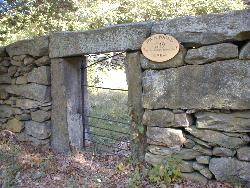 TOWN POUND TOWN POUND
Corner Route 102 & Pound Road
This stone enclosure, built in 1749, is the oldest pound in America. To get there, head south on Route 102 from Acote's Cemetery; Pound Road is just after the Glocester Police Station on the left.
A. YOUNG HOUSE (c. 1850)
This Greek Revival home has its gable end to the street.
Sources:
Chepachet.com
"Welcome to Historic Chepachet Village" - a publication of the Town of Glocester; Office of the Main Street Coordinator, David Balfour; and Town Historian, Edna Kent (2000).
|